The Benefits of Bilingual Early Learning
Young children are natural language learners. They listen closely to the people around them, notice patterns, copy sounds, and connect words with familiar people, objects, and experiences.
When children experience more than one language during their early years, they begin building communication skills that can support learning, relationships, and cultural connection. Bilingual early learning does not need to feel like a formal language lesson. It can happen naturally through songs, stories, conversations, movement, outdoor exploration, and everyday classroom routines.
At VidaLife School, children experience English and Spanish as meaningful parts of their day. Our bilingual educators create opportunities for children to hear and use both languages while they play, explore, create, and build relationships.
What Is Bilingual Early Learning?
Bilingual early learning gives children regular opportunities to hear, understand, and eventually communicate in two languages.
For young children, this works best when language is connected to real experiences. A teacher might sing a greeting song in Spanish, name colors during an art activity, introduce nature words outside, or repeat a familiar classroom direction in both English and Spanish.
These interactions allow children to discover what words mean through repetition, movement, facial expressions, objects, and relationships. Rather than memorizing lists of vocabulary, children experience language as a practical and enjoyable way to connect with the world around them.
1. It Strengthens Communication and Listening
Learning begins with listening. Before children can use a new word, they need opportunities to hear it in meaningful situations.
When children regularly experience English and Spanish, they practice paying attention to sounds, expressions, gestures, and context. A child may begin by recognizing a familiar greeting, classroom direction, or song before feeling ready to say the words independently.
These listening experiences help children understand that there can be more than one way to express an idea. They also encourage children to pay closer attention to how other people communicate.
2. It Builds Language Awareness
Exposure to two languages helps children notice how words and sounds work.
They may discover that one object can have two names, such as “water” and “agua,” or that a familiar song can be enjoyed in both English and Spanish. As children make these connections, they begin developing an awareness of language that can support future vocabulary and literacy learning.
The American Speech-Language-Hearing Association notes that multilingualism can support skills such as learning new words, understanding different perspectives, categorizing information, and connecting with other language users.
Every child develops at an individual pace, but regular, encouraging exposure gives children a strong foundation from which to continue learning.
3. It Encourages Cultural Connection
Language is closely connected to family, community, traditions, stories, and identity.
Learning Spanish gives children an opportunity to experience another language with curiosity and respect. For children from Spanish-speaking families, hearing their home language at school can help them feel recognized and included. For children who are new to Spanish, bilingual learning provides an early introduction to people and experiences that may be different from their own.
These experiences help children understand that differences are something to explore and appreciate. They also support VidaLife’s goal of nurturing kind children who value relationships and care about the people around them.
4. It Builds Confidence Through Practice
Children do not need to pronounce every word perfectly to benefit from bilingual learning.
They may listen quietly at first, respond through movement, repeat part of a song, or combine words from both languages. This is a normal part of multilingual development. According to the American Academy of Pediatrics, using words from different languages in the same sentence does not mean a child is confused.
Supportive teachers give children time to listen and participate without pressure. Every attempt is treated as part of the learning process, helping children feel more comfortable trying new words and communicating in new ways.
5. It Creates More Opportunities for Connection
Language helps children build relationships.
A child who understands words in another language may be able to connect with relatives, teachers, classmates, neighbors, and members of the wider community in new ways. Even simple words and phrases can help children recognize similarities, express kindness, and participate in shared experiences.
Bilingual early learning also communicates an important message: every language, family, and culture has value.
Will Learning Two Languages Confuse a Child?
No. Children are capable of learning more than one language.
Multilingual children may know certain words in one language and other words in another. They may also temporarily combine languages while speaking. These patterns are expected and do not mean that the child is confused.
The American Speech-Language-Hearing Association explains that learning multiple languages does not cause or worsen speech and language problems. A strong foundation in one language can also support the learning of another.
If a family has concerns about a child’s speech or language development, those concerns should still be discussed with the child’s pediatrician or a qualified speech-language pathologist. A true communication difficulty generally appears across all the languages a child uses.
What Bilingual Learning Looks Like at Different Ages
Bilingual early learning changes as children grow. VidaLife introduces English and Spanish in ways that complement each classroom’s developmental focus.
Infants
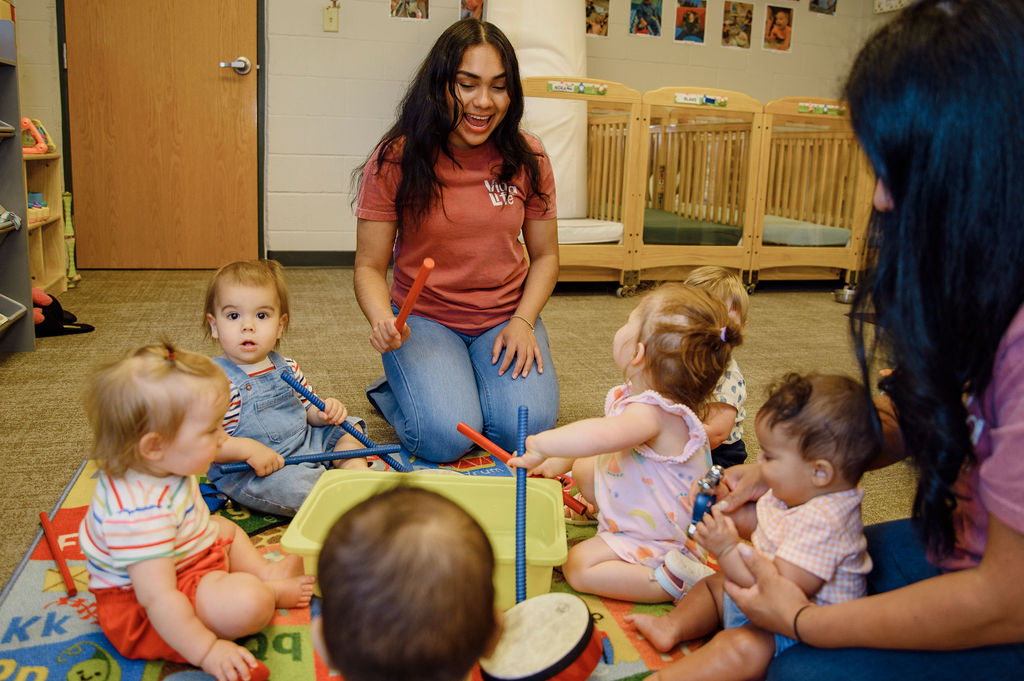
In our Infant Classroom, babies experience English and Spanish through songs, stories, gentle conversation, and responsive caregiving routines. Teachers may name familiar objects, describe what is happening, or sing while feeding, changing, playing, and comforting.
At this age, language learning is closely connected to secure relationships. Babies learn by hearing familiar voices and experiencing warm, consistent interactions.
Transitional Toddlers
Children in the Transitional Toddler Classroom begin participating in more group activities as they prepare for the routines of the Two-Year-Old Classroom.
Simple words, songs, movement activities, greetings, and classroom directions help children connect language with actions and familiar experiences.
Two-Year-Olds
In the Two-Year-Old Classroom, children are developing independence and rapidly expanding their communication skills.
English and Spanish are incorporated into songs, stories, choices, play, and daily routines. Repetition helps children recognize new words and become comfortable using them when they are ready.
Three-Year-Olds
Children in the Three-Year-Old Classroom experience more Spanish throughout the day as their conversations, imaginative play, and group participation grow.
Weekly themes, stories, show and tell, learning stations, and classroom discussions create meaningful opportunities to strengthen vocabulary in both languages.
Four-Year-Olds
The Four-Year-Old Classroom combines bilingual learning with early academics, social-emotional development, outdoor exploration, and kindergarten preparation.
Children can practice using language during stories, nature observations, creative projects, group games, and conversations with teachers and classmates.
Five-Year-Olds
In the Five-Year-Old Classroom, children continue building communication skills while strengthening kindergarten readiness.
English and Spanish are woven into hands-on learning, classroom discussions, songs, stories, projects, and outdoor experiences. Children are encouraged to listen carefully, express their ideas, ask questions, and communicate confidently.
How VidaLife Introduces Spanish Naturally
At VidaLife, bilingual early learning is part of the day rather than an isolated activity.
Children may experience Spanish through:
- Greeting songs and everyday conversations
- Books and storytelling
- Music and movement
- Colors, numbers, shapes, and familiar objects
- Classroom routines and simple directions
- Art, sensory, and STEM stations
- Outdoor play and nature exploration
- Conversations with bilingual teachers
This approach gives children repeated exposure without turning language learning into a test. Children can participate through listening, movement, gestures, singing, or speaking based on their comfort and developmental readiness.
Our screen-free environment also keeps language connected to real relationships and experiences. Children learn from teachers, classmates, nature, play, and the world immediately around them.
How Families Can Support Bilingual Learning at Home
Families do not need to speak Spanish fluently to encourage a child’s interest in language. Simple, consistent experiences can make language learning feel familiar and enjoyable.
Try these ideas at home:
- Sing a favorite song in English and Spanish.
- Read bilingual picture books together.
- Practice a few familiar words during everyday routines.
- Count objects while playing or getting dressed.
- Name colors during art projects or outdoor walks.
- Celebrate your child’s attempts without correcting every mistake.
- Continue using the language your family speaks most comfortably.
Parents and caregivers provide the richest language experiences when they speak naturally and confidently. Families should not feel that they need to stop using a home language in order to support English development.
What Should Parents Look for in a Bilingual Early Learning Program?
When exploring bilingual child care in Indianapolis, ask how the second language is incorporated into the program.
Helpful questions include:
- Are bilingual teachers regularly present in the classroom?
- Is the language used during everyday activities?
- Do children hear the language through conversation, music, books, and play?
- Is participation encouraging rather than pressured?
- Are children’s home languages and cultures respected?
- How does language learning change for different age groups?
- How are families kept informed about classroom learning?
The goal should be meaningful exposure and connection, not simply memorizing vocabulary.
Explore Bilingual Early Learning at VidaLife School
VidaLife School provides bilingual, nature-based early learning for children from infancy through age five. Children experience English and Spanish while building relationships, exploring nature, participating in hands-on learning, and developing the confidence to express their ideas.
Located at 11605 Pendleton Pike in Indianapolis, VidaLife serves families throughout Lawrence, Oaklandon, Geist, Fort Harrison, and northeast Indianapolis.
Explore all VidaLife classroom programs to find the right environment for your child. When you are ready to experience our campus and meet our educators, you can also schedule a personal tour.
Frequently Asked Questions About Bilingual Early Learning
Does my family need to speak Spanish at home?
No. Children can benefit from hearing and using Spanish at school even when their family primarily speaks English at home. Families can support the experience through songs, books, and an encouraging interest in what their child is learning.
Can learning two languages cause a speech delay?
Learning two languages does not cause or worsen a speech or language delay. Children may know different words in each language or mix languages while speaking, which can be a normal part of multilingual development.
What if my child mixes English and Spanish?
Mixing words from both languages is common for multilingual children and does not mean they are confused. As children gain experience, they become better at choosing words based on the person, setting, and situation.
Do babies benefit from bilingual learning?
Yes. Babies begin learning about language long before they say their first words. Songs, stories, facial expressions, and warm conversations help infants become familiar with the sounds and rhythms of both languages.
How is Spanish introduced at VidaLife?
Spanish is introduced naturally through songs, stories, conversations, classroom routines, guided activities, and interactions with bilingual teachers. The approach changes based on the children’s ages and developmental needs.
Will my child become fluent in Spanish?
Language development depends on the amount, consistency, and quality of exposure a child receives over time. VidaLife provides a meaningful foundation and regular opportunities to hear and use Spanish, but fluency should not be promised from an early learning program alone.
What ages does VidaLife serve?
VidaLife offers early learning programs for children from six weeks through five years old. Families can review each classroom and its developmental focus on the Programs page.
See What Learning Beyond the Classroom Looks Like
Explore our four-acre campus, meet our staff, and see what a day at VidaLife can look like for your child.